
IT & OT
What is the difference between IT and OT?
Educational content
June 15, 2025
5 min read
Traditionally, IT and OT used to operate in separate domains. However, their convergence is reshaping how companies manage their data, processes, and even critical infrastructure. Here, we define IT and OT, highlight some of their key differences, and explore where they intersect. Also, we will examine some of the most common challenges of IT/OT in the renewable energy industry.
What is OT versus IT?
In the energy sector – and particularly within renewable power plants – Operational Technology (OT) and Information Technology (IT) serve separate yet increasingly interconnected roles.
OT refers to the hardware and software used to monitor and control physical equipment and processes within a plant. This includes everything from network infrastructure and fiber optic cables to systems like SCADA and PLCs that gather on-site data or send control signals. OT is foundational to ensure that physical assets operate efficiently, safely, and in line with regulatory or grid requirements.
IT focuses on data handling, communication, and administrative systems. This includes tools that manage access to remote software, internet connectivity, cybersecurity (like firewalls), and enterprise systems such as email and data storage servers. IT is what enables reliable communication and data exchange within and beyond an organization.
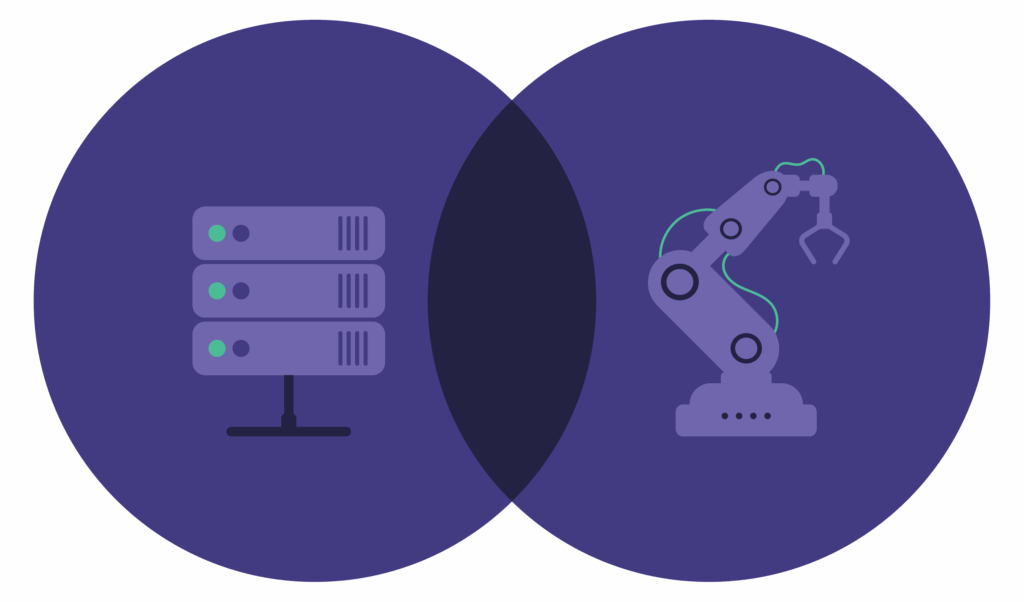
While both IT and OT are essential individually, the real value lies where they overlap. By integrating the data management capabilities of IT with OT’s real-time process control, operators gain better visibility, advanced analytics, and the ability to remotely monitor and optimize asset performance. This integration helps enhance decision-making, drives efficiency, and supports more predictive maintenance and automation.
What OT and IT challenges is the energy industry facing?
A key challenge in many renewable power plants today lies in the difference between outdated OT systems and modern IT requirements. Many sites still rely on legacy equipment, often more than a decade or two old, which has not kept up to date with evolving standards or the rapid expansion of digital infrastructure in renewables.
For example, if the OT you are dealing with is part of the original 20-year-old power plant, the OT data you can retrieve will consequently not match the requirements and standards we have today.
Outdated technology often results in limited or even poor data quality and a lack of compatibility with newer systems. In some cases, critical components are no longer supported by manufacturers. Many of these issues stem from fast-paced development during subsidy-driven growth periods, where long-term fleet management was often deprioritized.
The result is a growing gap between the quality and usability of OT and IT data. But this also represents an opportunity. Today's insights, tools, and expertise enable operators to modernize these systems - upgrading legacy components, redesigning network layouts, and unlocking the full potential of digital plant management.
Allan Brønden Christensen - Technical Director

Thus, this outdated technology often results in limited or even poor data quality and lacks compatibility with newer systems. In some cases, critical components are no longer supported by manufacturers. Many of these issues stem from fast-paced development during subsidy-driven growth periods, where long-term infrastructure planning was often deprioritized.
The result is a growing gap between the quality and usability of OT and IT data. But this also presents an opportunity. Today’s insights, tools, and expertise enable operators to modernize these systems – upgrading legacy components, redesigning network layouts, and unlocking the full potential of digital plant management.
In a recent incident (April 2025), Spain and Portugal, but also parts of France, were hit by massive power outages. Although an official cause has not yet been identified, it highlights the importance of strengthening IT/OT integration for more intelligent grid balancing and infrastructure upgrades.
What impact do OT and IT have on cybersecurity and critical infrastructure?
As OT and IT become more integrated, cybersecurity emerges as one of the most critical challenges facing renewable energy operators and the protection of critical infrastructure. As OT systems become more interconnected and exposed to the internet, they also become more vulnerable to cyber threats.
According to ENISA (European Network & Information Security Agency), more than 200 cyber incidents targeting the energy sector were reported in 2023. Half of these were directed specifically at Europe.
When digital infrastructure becomes outdated, the risk of breaches, failures, and downtime increases significantly. This means that the optimal path forward should include both replacing legacy hardware and software. It also means building an architecture that is future-proof, secure, and capable of managing diverse technologies across a fleet or even across countries.
Success lies in deploying flexible solutions that adapt to both new builds and older plants. As renewable portfolios grow more complex, safeguarding operational continuity and critical infrastructure becomes increasingly important. Achieving this will require proactive planning, cross-functional expertise, and a long-term commitment to digital resilience.