
Solar and BESS
Solar and BESS: The power couple driving renewable system transformation
Trend piece
March 23, 2026
5 min read
The growing integration of solar photovoltaic (PV) generation and battery energy storage systems (BESS) is reshaping power markets. It is strengthening grid stability across regions, and proving that clean energy can be flexible, reliable, and ready for scale.
Solar photovoltaic and battery energy storage systems are no longer being developed in parallel. Across both the US and Europe, they are increasingly designed, financed, and operated together. They form a powerful combination. Together, they address both clean energy production and the need for greater system flexibility. In 2025, this combination proved its value, driving record storage installations across Europe and powering hybrid plants that balance output and demand. Industry leaders like European Energy are at the forefront of this shift. They are building large-scale solar-plus-storage assets demonstrating what is possible when generation and storage work hand-in-hand. In this blog post, we explore some of the advantages that this power couple brings to the industry. And dive into statistics demonstrating the duo's industry popularity.
Why are solar and BESS a true power couple?
Solar PV generates clean energy when sunlight strikes the panels, with output typically peaking midday. As solar penetration continues to grow across many power markets, this concentrated midday production increasingly exceeds system demand. The result is sustained downward pressure on wholesale electricity prices during solar hours and, in some regions, frequent periods of very low or even negative pricing. When the grid cannot absorb all available generation, system operators are forced to curtail solar output, leaving valuable renewable energy unused.
This phenomenon is often referred to as the duck curve. The mismatch between output and demand creates a curve that resembles a duck’s belly – often played out in the California power grid, as the example below shows.
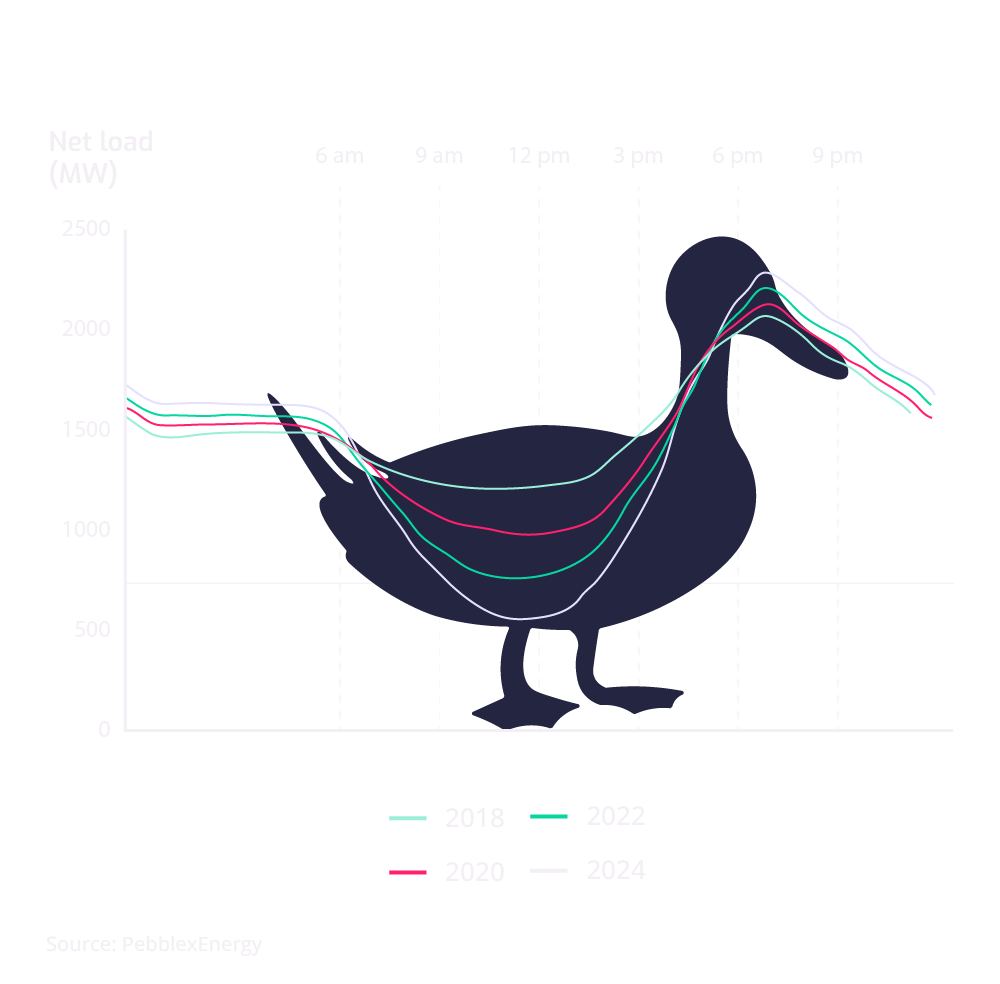
But BESS is about to change this dynamic – to the better. By capturing surplus solar output and discharging it during peak-demand periods, such as evenings or cloudy periods, storage smooths supply and enhances grid stability. To illustrate this, some highlight that the curve shifts from looking like a duck to a cowboy hat instead.
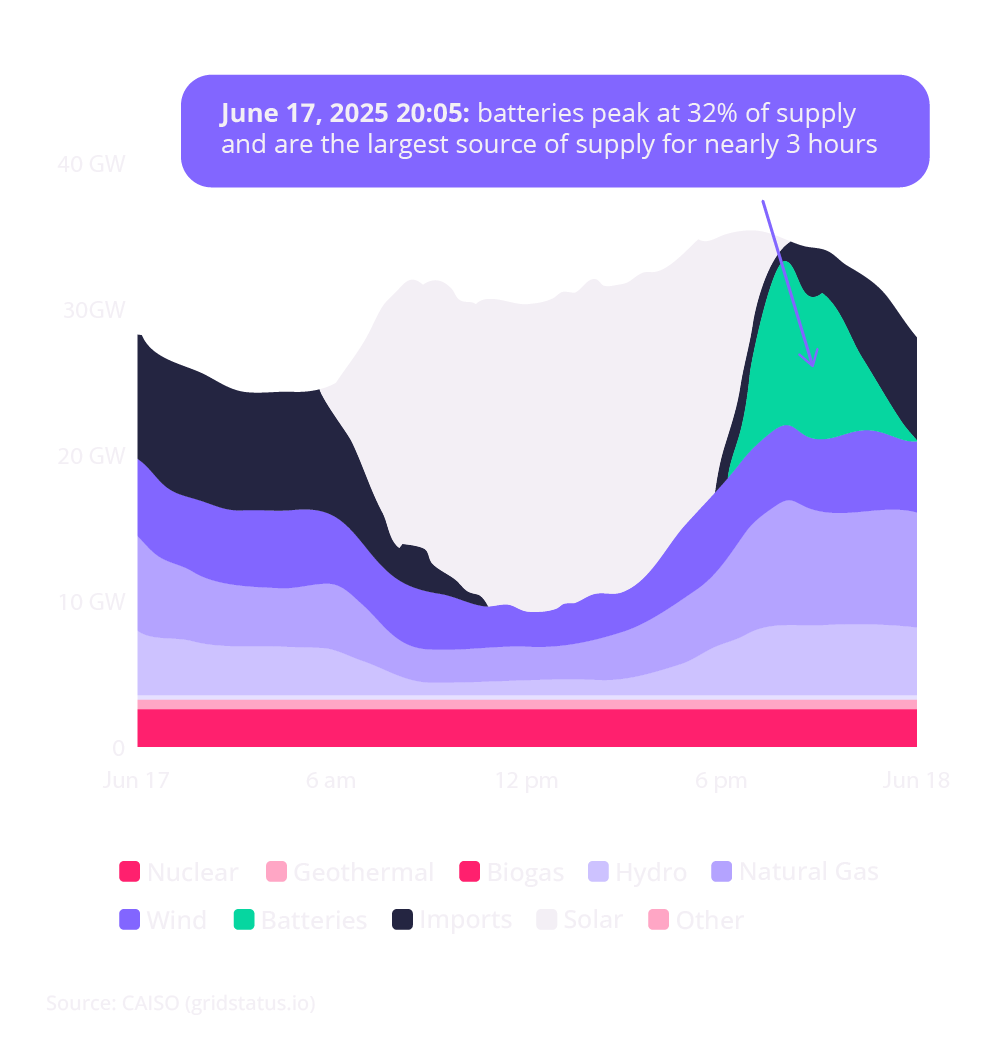
2025 was the year of record growth for solar and BESS
Several milestones for both solar and battery storage deployment:
1.
A recent report from Solar Power Europe shows that the European Union installed 27.1 GWh of new battery storage capacity in 2025, a new record year powered by strong utility-scale deployment. This marks 45% year-on-year growth and confirms that Europe has already expanded its battery fleet tenfold since 2021, rising from 7.8 GWh to 77.3 GWh today.
2.
According to lead forecasts, solar and battery storage accounted for the majority of new US power capacity additions. In 2025, they were projected to account for approximately 81% of the 63 GW of utility-scale capacity growth, with solar PV and BESS together accounting for the bulk of that expansion.
3.
PV magazine reported that global solar capacity continued to climb, with notable installations such as Ukraine’s circa 1.5 GW of new solar PV in 2025, emphasizing the growing interest in PV and paired storage projects.
No doubt that the infrastructure for solar and storage is scaling, driven by the increased need to manage variability, support flexibility, and maximize the value of clean energy.
Solar and BESS are on the agenda in every boardroom
Opoura recently shared a press release announcing new BESS orders from several major industry players. Among them is an order from a long-term customer in Poland to integrate one of Europe’s largest Battery Energy Storage Systems into their Portfolio SCADA system.
These incoming BESS orders reflect a clear shift in the industry. Solar and storage are increasingly being designed together from the outset, allowing developers and asset owners to capture the full value of combining generation and flexibility in one integrated setup. European Energy, a renewable developer in Northern Europe, is an example of a renewable developer that has actively embraced integrated solar and storage solutions as part of its strategy to deliver cleaner, more resilient energy assets.
In a recent announcement, they stated that hybrid projects will now become their standard offering, replacing standalone solar as the default approach. As market conditions evolve and flexibility becomes a competitive advantage, we expect more developers to follow the same path.
Scaling solar and BESS for the future
The progress seen in 2025 and the strategic shifts in the market show that solar and BESS are no longer emerging technologies, but are becoming foundational components of modern power systems, pushed forward by both regulations and strategic prioritizations.
Policy frameworks and market incentives are accelerating utility-scale BESS deployment.
Developers are prioritizing hybrid project design to enhance asset value and grid contribution.
Industry strategies are shifting toward integrated portfolios that support PV generation with flexible storage.
In summary, solar and BESS are becoming a defining combination in the transformation of energy systems. Together, they improve renewable energy performance, increase reliability, and help close the gap between variable generation and the flexibility that the grid requires.
Looking toward 2030, the pairing of solar PV with BESS will play a central role in achieving decarbonization targets while maintaining stable, resilient power systems.