
Ancillary services
France’s big balancing act: Renewables required to join mFRR from 2026
Market insights
November 07, 2025
6 min read
France has announced a major reform in electricity market design. In 2026, all power generation plants above 10 MW – including wind and solar – must participate in the national balancing mechanism, which includes Manual Frequency Restoration Reserve (mFRR). In this blog post, we explore what the change means for renewable plant owners in France.
The 31 December 2025 will be more than a night of celebration across France. It will also mark a turning point in how the country manages balance and flexibility in its electricity grid. In the new year, renewable energy producers with plants above 10 MW will become mandatory participants in the national balancing mechanism (“Mécanisme d’ajustement”). The requirement follows a legal amendment introduced in May 2025.
mFRR – a new role for renewables
Balancing the grid is essential for keeping supply and demand in sync. Typically, Transmission System Operators (TSOs) activate upward or downward flexibility offers from market participants to correct imbalances in real-time.
Until now, balancing has relied mainly on dispatchable resources such as gas, coal, or hydro. Renewable energy producers, particularly those connected at the distribution level, played only a marginal role. From 2026, large-scale renewable plants will be required to take an active role in grid balancing operations. They will need to provide both upward and downward flexibility through the tertiary reserve ancillary service known as the Manual Frequency Restoration Reserve (mFRR).
Balance responsibility and reward go hand in hand
The move towards increased requirements for flexibility comes as no surprise. The rapid growth of intermittent renewable generation has created new challenges for the French TSO, Réseau de Transport d’Électricité (RTE). Periods of high solar and wind output often result in oversupply, while downward flexibility remains scarce. This imbalance has led to insufficient downward balancing offers available and ad hoc curtailments outside of market structures.
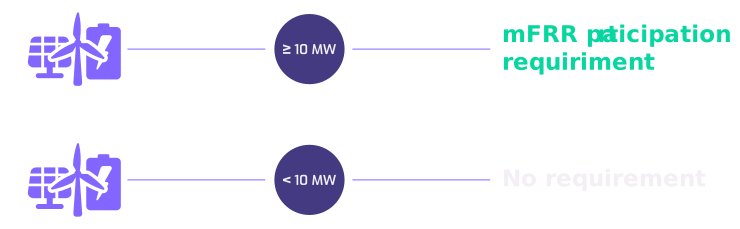
By mandating mFRR participation, France aims to unlock the flexibility potential of large renewable installations above 10 MW. Thresholds may differ by technology, but 10 MW remains the baseline. This means that renewable assets will now play an active role in maintaining a balance between supply and demand. They can do this by offering downward flexibility when generation needs to be reduced or by providing upward support through hybrid setups such as battery energy storage systems (BESS).
Within the existing pay-as-bid framework, renewable generators curtailed by RTE are compensated at the price of their submitted downward offer. Likewise, flexible assets providing upward activation receive payment at their offered rate.
How renewable plant owners can get ready for mFRR compliance?
The responsibility and reward received with the new law push renewable power producers to think strategically when it comes to generation prioritization and asset management. The opportunity to bid for new balancing offers transforms curtailment from a cost into a remunerated service – enabling new revenue potentials for flexible renewable portfolios.
However, becoming compliant with this new obligation requires technical readiness – and the clock is ticking. Plants generating power above 10 MW will need to have software systems in place that can handle real-time data exchange, the ability to submit balancing offers to RTE, and intelligent control capabilities that can handle mFRR activations and allow for start and stop of assets according to the set points received.
So, meeting these new obligations will require more than regulatory alignment, but also a robust digital infrastructure. Scalable platforms that can connect both to local SCADA systems/PPCs and to market interfaces will become essential to ensure compliance and unlock value from flexibility. In practice, this means integrating monitoring, control, and market participation into one cohesive environment. Choosing software that can handle mFRR activations is equally a necessity.
The bigger picture: mFRR movements across Europe
France isn’t acting in isolation. Across Europe, renewables are being drawn into balancing markets as part of the Clean Energy Package. The shift to 15-minute settlement periods and cross-border balancing platforms like MARI and PICASSO all point in the same direction: renewables are no longer just variable supply but also essential flexibility providers.
At the same time, if France and RTE can make mFRR participation straightforward and fair, this could become a model for other countries. At Opoura, we are keeping a close eye on the development of grid requirements in both Europe and the US – all the way from building TSO-compliant plant setups to assessing the impact of rising grid regulations on asset management and optimization.