
SCADA Overview
What is SCADA?
Educational content
June 06, 2024
9 min read
SCADA systems explained. Get the answers to all your questions about SCADA systems.
What does SCADA stand for?
Supervisory Control and Data Acquisition (SCADA) systems are used for controlling, monitoring, and analyzing industrial devices and processes. The system consists of both software and hardware components and enables remote and on-site gathering of data from the industrial equipment. In that way, it allows companies to remotely manage industrial sites such as wind and solar farms, because the company can access the turbine data and control them without being on site.
What is a SCADA system used for?
The main purpose of SCADA software is to monitor and control equipment in industrial processes. Thus, SCADA systems are seen almost everywhere. Typically, SCADA systems are used in:
Manufacturing

Transportation

Water management
Renewable energy
Oil and gas

Power distribution and control
In these industries, SCADA software provide valuable information to key stakeholders. They can use the system to improve the performance of the industrial plants, keep track of the plants’ efficiency, and mitigate errors and downtime through messages received from the system.
In today’s industrial advanced world, SCADA systems are crucial for operating industrial plants more efficiently, as they are much easier and faster in collecting essential data. This allows for better allocation of resources in many businesses.
A SCADA system connects to many different types of equipment. It monitors and controls everything from weather sensors and pumps to power production and motors, depending on what kind of data is needed.
How does a SCADA system work?
A SCADA system consists of three main system components. Combined, they ensure that data is transmitted from the equipment that needs to be monitored and controlled (sensors, motors, etc.) to an interface where the data can be analyzed and used for reporting.
The connecting link in the SCADA architecture is the Programmable Logic Controllers (PLCs) or Remote Terminal Units (RTUs). These are microcomputers that interact with both the equipment (also called field devices) on the one hand, and HMIs, which are Human Machine Interfaces, on the other hand. HMIs are also referred to as graphical user interfaces or web clients.
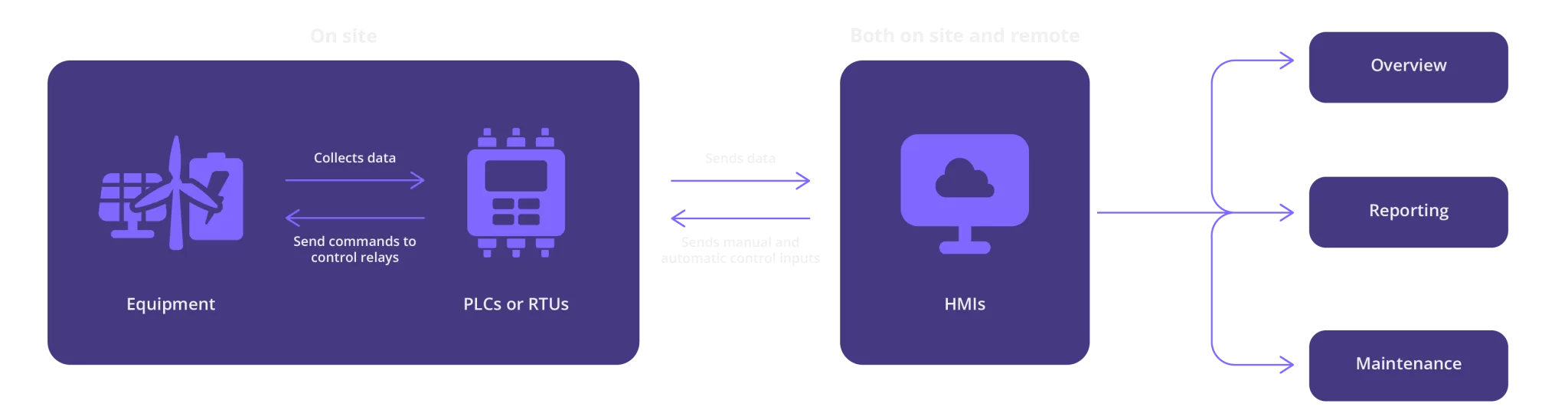
As the illustration shows, the PLCs and RTUs work as local collection points that send and translate data to the remote or on-site HMI and send back control commands to the field devices.
The human operators access the data through the HMI, which can either be cloud-based or based on their own servers. The software interprets and displays the data in an easy-to-understand manner, so operators can quickly and simply analyze and react to alarms.
Some SCADA software systems also include options for automatic control actions and an automatic reporting engine for easy-made reports.
Alarms and events in SCADA software
An example
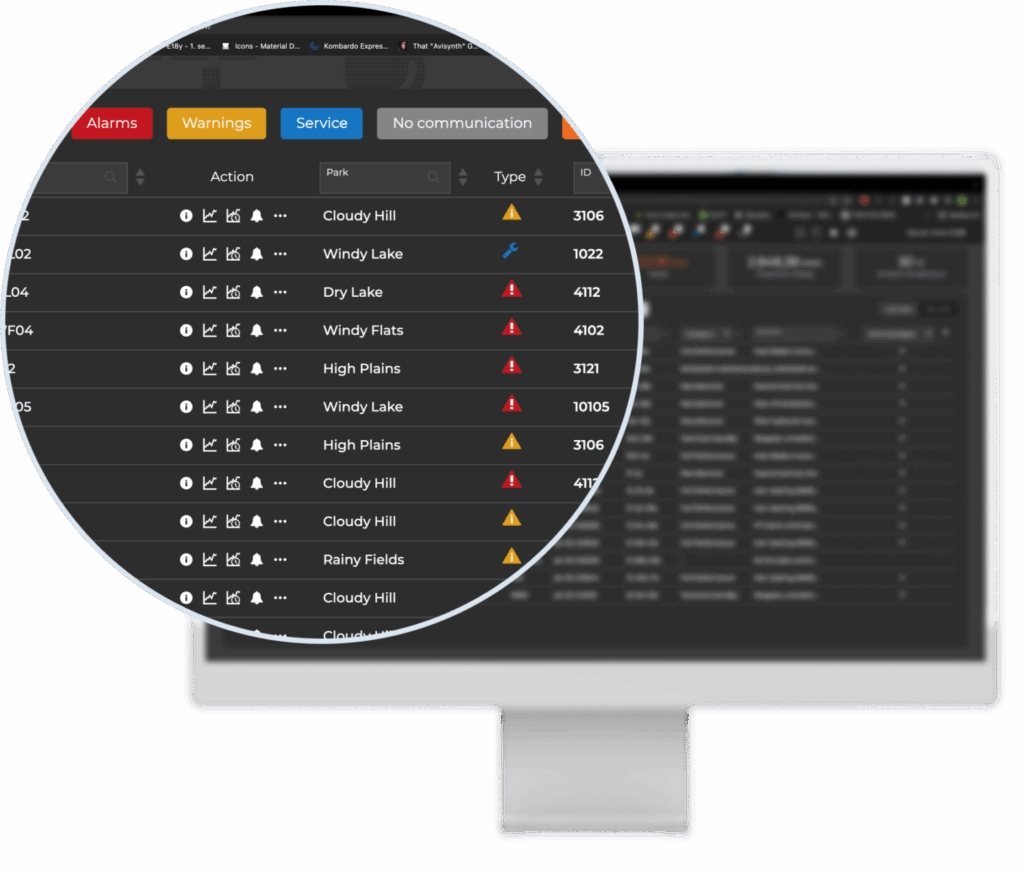
Being able to react quickly to alarms and events can be vital for industrial plant operations. A typical scenario will be that the SCADA software notifies the plant operator in the HMI if something is not running correctly.
Like a notification on your phone, the plant operator receives a message that he needs to react and assess the situation. If he makes the judgment that the equipment needs to be stopped, he can do that directly in the HMI, which sends commands to the PLCs or RTUs, which also send the commands and stop the equipment on site.
Due to the notification from the SCADA system, the operator can react quickly to emerging issues and prevent possible maintenance costs.
Why is a SCADA system important for renewable power plants?
There are many benefits of a SCADA system. Overall, SCADA systems help optimize production and control production according to regulations within the industry. In many cases, SCADA software is also used for troubleshooting purposes, as maintenance has become a big part of securing a continuous production flow without too many errors.
To fully understand the importance of a SCADA system, we need to go back to when industrial plants were monitored manually and relied on personnel to be on site during production. The personnel had to oversee and control operations and react to emerging issues. This was not only costly but could be dangerous for the personnel.
However, as industrial sites scaled up and became more remote, the need for more automatic solutions arose.
Fast forward to today, the initial need for more automation is still driving the SCADA development. With more automatic and semi-automatic processes, businesses can allocate their resources differently and save money in the long run.
What kind of data does a SCADA system collect?
A SCADA system can collect any type of data from plant equipment, such as temperature, pressure, and speed data, as long as there is a connection to the equipment. Data from the equipment is the raw data that the PLCs or RTUs then translate into comprehensible information for human operators to act upon.
What is very useful is that a SCADA system typically collects both live and historical data. Live data is often used for maintenance purposes as well as real-time tracking. On the other hand, historical data is often used for reporting and to improve plants’ performance.
The monitored equipment doesn’t have to be from the same vendor for the SCADA software to transform the data into understandable information. The equipment just needs to have an accessible communication protocol that the PLCs or RTUs can utilize. This opens for uniform information exchange across plants.
In the wind sector, the IEC 61400-25 is the international standard for communications for monitoring and control of wind power plants. The standard enables the exchange of data and information with different wind power plants independently of a vendor. When managing solar PV plants, the IEC 61850-7-4 and IEC 61850-7-420 are used as standards.
As part of Opoura’s commitment to interoperability and data transparency, Opoura has developed the Global Wind Data Tag-List and Solar PV Data Tag-List based on industry standards. The tag-lists turn raw data into smart, actionable insights through a streamlined naming convention.
How to integrate to different SCADA systems?
OEMs (Original Equipment Manufacturers) in renewable energy use proprietary protocols (communications rules) that can complicate communication with various controllers and devices. So, if asset owners manage different types of e.g. turbines, or turbines combined with solar, they have several SCADA software systems to navigate.
To overcome these challenges, some independent suppliers (like Opoura) have built competencies in driver development, ensuring that the independent SCADA system can communicate with a broad array of OEM systems – both on site and remote. This flexibility gives customers a powerful advantage: a SCADA system that supports interoperability across multiple platforms and vendors
Why are SCADA systems used in the renewable energy sector?
SCADA systems are used at any wind power plant today as they allow for remote monitoring and control of the wind turbines. As wind power plants or wind farms have grown in size, it is no longer possible or favorable to visit every wind turbine to collect data for monitoring and control purposes.

You can use SCADA systems in wind parks

You can use SCADA systems in solar PV plants

You can use SCADA systems in hydropower plants
Offshore wind parks are also on the rise these years, which means remote access to the wind turbines becomes even more crucial. With a SCADA software system, a lot of tasks can be performed without even visiting the wind turbine.
Other renewable power plants, such as solar PV (Photovoltaic) or hydropower plants, also rely on SCADA systems to gain remote access and control. These plants are often placed in remote areas, where it is both difficult and costly to bring personnel on site. As solar PV is projected to become the leading renewable energy source by 2030, SCADA systems become even more crucial to ensure remote access and control.
Another reason why SCADA systems are so essential in the renewable energy sector is that SCADA software enables monitoring and control of power production and power production loss. The demand for electricity from renewable power plants is growing day by day as the industry moves away from harnessing energy from fossil fuels to more green alternatives.
The renewable plant owners are thus looking to optimize their power production as much as possible. Detecting any errors or under-performance quickly and effectively can be a way to reduce downtime of, e.g., wind turbines and optimize the overall performance of the power plant. Controlling the power output is also an effective way to comply with grid regulations and optimize the plant’s performance.
How can Opoura help me?
Opoura delivers solutions for the complete SCADA value chain. We operate in the renewable energy sector and have installed numerous SCADA systems for big players in the renewable energy sector.
The OneView® software is our future-proofed SCADA software that empowers the renewable energy sector. The system lets you monitor and control all your renewable assets – e.g., wind turbines or solar PV modules – in one single view. In that way, you don’t have to log in to several different systems to keep track of your different assets. Thus, asset management becomes a much easier task, and you can mitigate problems much quicker.